Athlete Dosing Myth: “More = Better” — Why Caffeine Can Hurt Performance
“I don’t care about safety, I care about performance.”
That mindset is common in competitive athletes. And in many areas of training, pushing harder does lead to better results.
But caffeine doesn’t follow that rule.
In fact, caffeine is one of the clearest examples in sports performance where:
More does NOT mean better.
It follows a very specific dose-response curve—and if you miss it, you don’t just lose the benefit…
you lose control of your performance.
The Inverted U: How Caffeine Actually Works
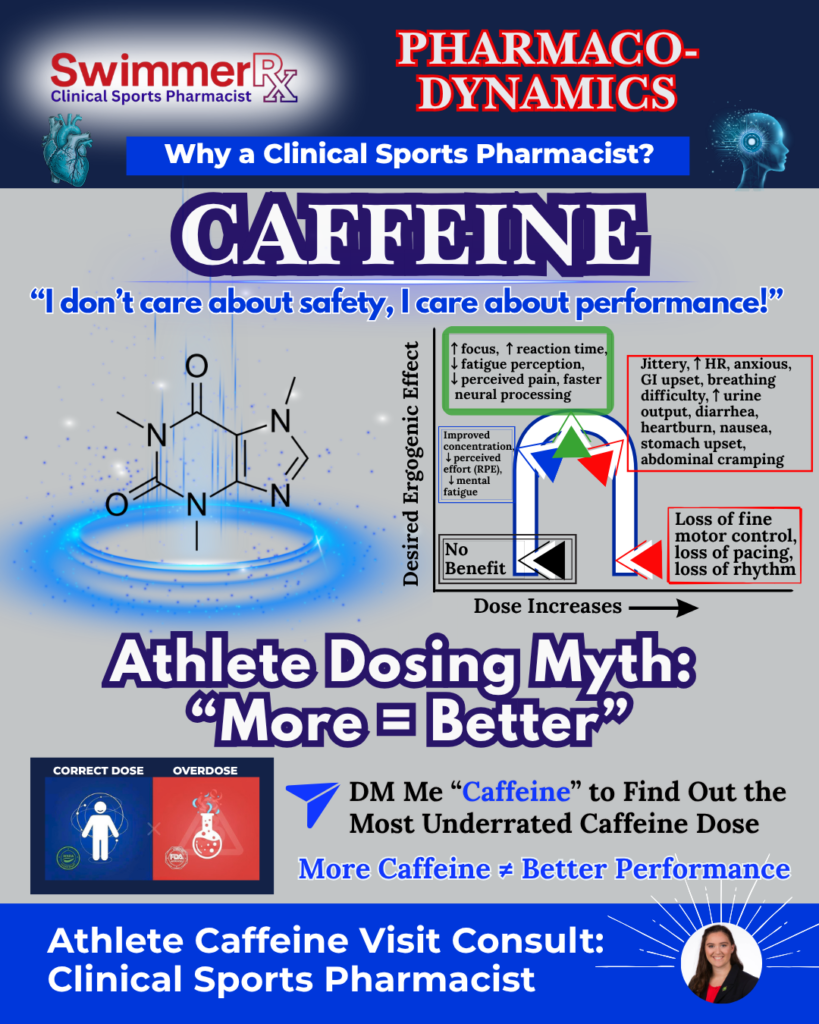
Caffeine’s effects follow an inverted U-shaped curve:
- Too little → no meaningful effect
- Optimal dose → peak performance
- Too much → performance declines
This is not theoretical. This is pharmacodynamics.
At the optimal dose:
- ↑ Focus
- ↑ Reaction time
- ↓ Fatigue perception
- ↓ Perceived effort (RPE)
- Faster neural processing
This is where caffeine becomes an ergogenic aid.
What Happens When You Take Too Much
This is where most athletes get it wrong.
Instead of staying in the optimal zone, they increase the dose—thinking it will amplify performance.
Instead, it flips.
CNS + Cardiovascular Effects:
- Jitteriness
- Increased heart rate
- Anxiety
- Overstimulation
GI Effects:
- Diarrhea
- Nausea
- Stomach upset
- Abdominal cramping
Respiratory + Systemic:
- Breathing difficulty
- Increased urination
The Most Important Performance Loss: Control
Athletes don’t lose because they’re not strong enough.
They lose because they lose control.
High caffeine doses cause:
- Loss of fine motor control
- Poor pacing strategy
- Disrupted rhythm
This is critical in sports like:
- Swimming
- Track
- Gymnastics
- Baseball / Softball
- Lacrosse
- Any sport requiring precision timing
You may feel more “amped” but your execution breaks down.
Why This Happens (Pharmacodynamics)
Caffeine works by:
- Blocking adenosine receptors
- Increasing cAMP
- Increasing catecholamines (epinephrine/norepinephrine)
At the right dose → performance enhancement
At higher doses →
- Excess stimulation
- Loss of coordination
- Increased cardiac workload
The Illusion of “Feeling Better”
One of the most dangerous aspects of caffeine:
It can make you feel better while performing worse.
Athletes often interpret:
- Increased energy
- Increased stimulation
as improved performance.
But in reality:
- Timing is off
- Stroke efficiency drops
- Decision-making declines
The Real Risk: Variability
The biggest issue isn’t just overdosing.
It’s inconsistency.
Same athlete. Same meet. Same dose.
Different outcomes depending on:
- Sleep
- Hydration
- Stress
- Hormones
- Drug interactions
This leads to:
Unpredictable performance
Where Most Athletes Go Wrong
- Copying teammate doses
- Using pre-workouts without knowing content
- Increasing dose under pressure
- Not adjusting for:
- Body weight
- Metabolism
- Medications
The Clinical Reality
Caffeine is not just a “boost.”
It is:
- A centrally acting stimulant
- A cardiovascular-active drug
- A dose-dependent performance modifier
Which means:
It requires precision, not guesswork.
The Key Takeaway
The difference between:
🏆 Peak performance
vs.
❌ Performance breakdown
is often:
Not whether you took caffeine, but HOW MUCH (dose)
Better Approach
Instead of asking:
“How much should I take?”
Ask:
“What is MY optimal dose?”
Because:
- Too little → no benefit
- Too much → loss of control
Conclusion
Caffeine is one of the most powerful tools in sports performance…but only when used correctly.
More caffeine doesn’t make you better.
It makes you unpredictable.
And in competition, unpredictability is where performance is lost.
If you’re using caffeine and haven’t dialed in your dose, you’re not optimizing… you’re guessing.
Contact me here: Contact Us
or schedule a free 15-minute consultation Book a Meeting
to see if you’re a good candidate for a personalized caffeine consult.
Stop leaving your performance up to chance.
Author: Dr. Marissa Blumenthal, PharmD, BCPS