
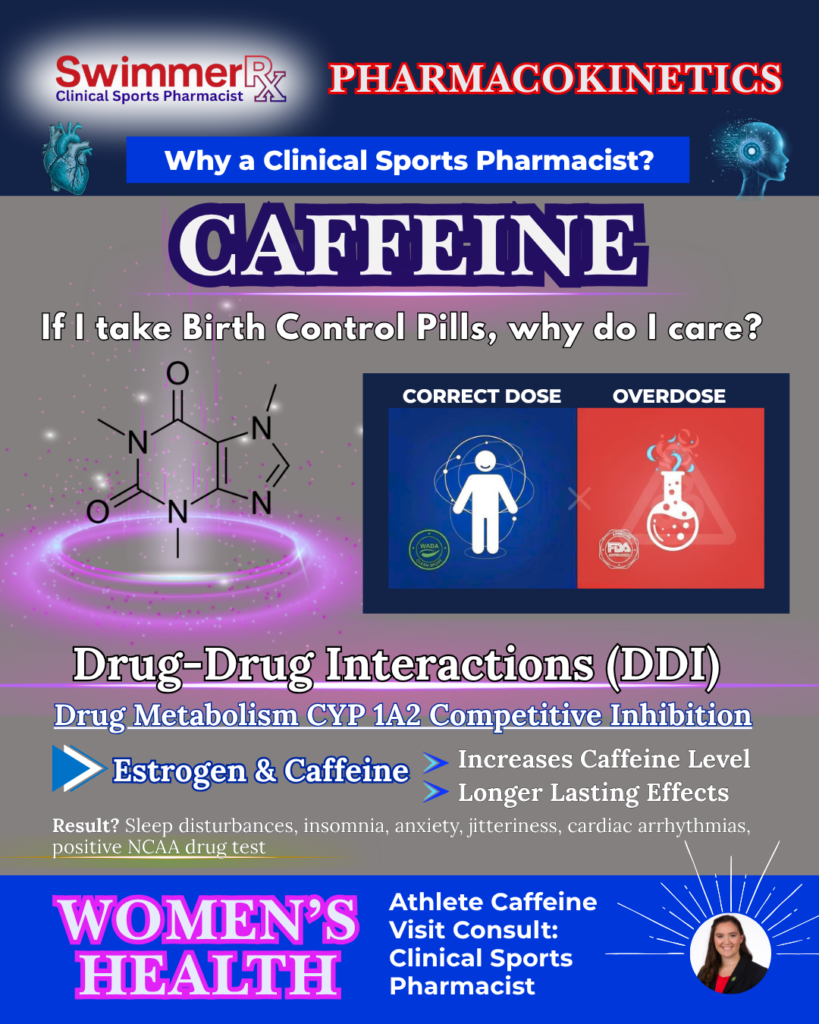
Caffeine Isn’t “Just a Supplement”: The Pharmacology Behind Metabolism, Birth Control, and Athlete Risk
Caffeine is one of the most widely consumed substances in the world and one of the most misunderstood.
In sports, it’s often treated like a harmless performance tool. In healthcare, it’s frequently minimized because of its accessibility. But from a clinical standpoint, caffeine behaves like a drug…with defined pharmacokinetics, pharmacodynamics, and clinically relevant drug–drug interactions.
One of the most overlooked interactions?
Caffeine + oral contraceptives.
This is not a minor detail. It’s a metabolism-driven interaction that directly impacts dosing, performance, and safety.
Caffeine Is a Drug: Here’s Why That Matters
Caffeine:
• Has a specific molecular structure
• Acts on defined receptors (adenosine antagonism)
• Undergoes hepatic metabolism (CYP1A2)
• Produces dose-dependent physiologic effects
• Has drug–drug interactions
That is the definition of a pharmacologically active agent.
From a clinical lens, caffeine should be treated with the same level of precision as any other drug affecting the cardiovascular and central nervous systems.
Pharmacokinetics: Where Metabolism Fits
To understand this interaction, you need to understand one core principle:
Pharmacokinetics = what the body does to the drug
This includes:
1. Absorption
2. Distribution
3. Metabolism
4. Excretion
Metabolism is the key driver here.
Caffeine is primarily metabolized in the liver by:
• CYP1A2 enzyme system
This enzyme determines:
• How fast caffeine is cleared
• How long it stays active
• How intense its effects are
Oral Contraceptives Change Caffeine Metabolism
Mechanism
Oral contraceptives Pills (OCP) specifically estrogen-containing:
• Inhibit CYP1A2 activity
This leads to:
• Reduced caffeine metabolism
• Prolonged half-life
• Increased plasma concentrations
Clinical Translation: Same Dose ≠ Same Exposure
Two athletes take the same caffeine dose:
• Athlete A (not on OCPs) → normal metabolism
• Athlete B (on OCPs) → slower metabolism
Result:
Athlete B experiences:
• Higher caffeine levels
• Longer duration of action
• Greater physiologic impact
This is a pharmacokinetic drug–drug interaction.
Why This Matters for Athletes
Caffeine is often used for:
• Reaction time
• Alertness
• Endurance support
But when exposure increases unintentionally, risk increases.
Potential Consequences
• Jitteriness
• Anxiety
• Sleep disruption
• Elevated heart rate
• Arrhythmias (e.g., SVT in susceptible individuals)
• Inconsistent performance
This is where performance optimization turns into performance variability.
The Problem: Dosing Without Context
Most athletes:
• Copy dosing strategies from teammates
• Follow generic recommendations
• Do not account for:
• Genetics (CYP1A2 variability)
• Medications (like oral contraceptives)
This creates a critical gap:
Caffeine is being used without understanding exposure.
This Is Pharmacokinetics → Therapeutics
This interaction demonstrates the full clinical chain:
• Pharmacokinetics → altered metabolism
• Pharmacogenomics → individual variability
• Therapeutics → real-world dosing decisions
If metabolism changes and dosing doesn’t adjust,
the outcome is no longer controlled.
What Should Be Done Instead
For athletes on oral contraceptives:
1. Adjust Dose
• Start lower than standard recommendations
• Avoid assuming tolerance
2. Monitor Response
• Heart rate
• Perceived stimulation
• Performance consistency
3. Time Appropriately
• Avoid late dosing due to prolonged half-life
4. Avoid Stacking Stimulants
• Decongestants
• ADHD medications
• Pre-workouts
The Bigger Picture: Athlete Healthcare Gap
This is not just about caffeine.
This is about a larger issue:
• Substances with drug-level effects are being used
• Without clinical interpretation
• In high-performance environments
The missing step:
Translating pharmacology into individualized care
Conclusion
Caffeine is not inherently unsafe—but it is not neutral.
When combined with oral contraceptives:
• Metabolism changes
• Exposure increases
• Risk profile shifts
And yet, dosing rarely adjusts.
This is where pharmacology matters.
Because performance is not just about what you take, it’s about how your body processes it.
If you’re using caffeine and haven’t dialed in your dose, you’re not optimizing… you’re guessing.
Contact me here: Contact Us
or schedule a free 15-minute consultation Book a Meeting
to see if you’re a good candidate for a personalized caffeine consult.
Stop leaving your performance up to chance.
Author: Dr. Marissa Blumenthal, PharmD, BCPS