
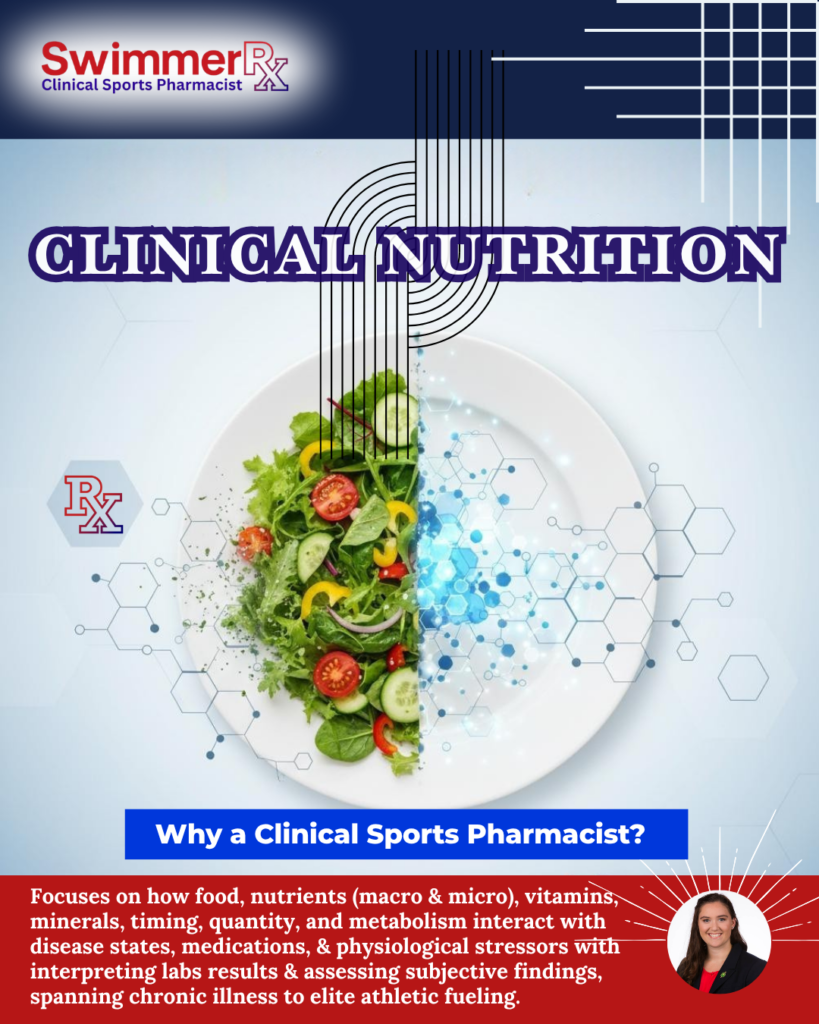
Clinical Sports Pharmacist vs Sports Dietitian (CSSD)
How We Actually Work Together in Athlete Healthcare
There’s a growing conversation in sports performance around who should be guiding athlete nutrition. The reality is not either/or it’s actually both, when used correctly.
But there are meaningful differences in training, scope, and application, especially once you move beyond whole food.
This is where clarity matters to drug tested athletes especially.
The Core Difference
Sports Dietitian (CSSD)
A Certified Specialist in Sports Dietetics (CSSD) is the gold standard for:
- Whole food nutrition
- Meal planning
- Fueling strategies
- Eating behaviors & relationships with food
- Performance nutrition across training cycles
They are the food-first experts.
Clinical Sports Pharmacist (CSP)
A Clinical Sports Pharmacist operates where:
- Biochemistry meets pharmacology
- Nutrition meets metabolism
- Supplements meet drug testing and safety
- Genetics in nutrition, metabolism, fitness, and medications
They specialize in:
- Drug–nutrient interactions management
- Supplement safety & contamination risk
- Dosing (caffeine, creatine, electrolytes, etc.)
- Pharmacokinetics under physiological stress
- Lab interpretation + metabolic impact
- Regulatory compliance (WADA, NCAA, FDA)
- Performance-based individual carbohydrate strategies in endurance sports
They are the “everything outside of whole food” experts. If it’s packaged and you’re a drug tested athlete, it’s a risk for contamination and that’s where working with your Sports Dietitian and Clinical Sports Pharmacist is important to learn what packaged food is perfectly fine for drug testing considerations and what ones demonstrate risk. Think Gatorade gummy positive drug test with USADA.
Where the Overlap Happens
There is real overlap — and that’s intentional.
| Area | Sports Dietitian (CSSD) | Clinical Sports Pharmacist (CSP) |
|---|---|---|
| Individual fueling | ✅ | ✅ |
| Youth team nutrition | ✅ | ✅ |
| Supplement evaluation | ✅ | ✅ |
| Food dosing (macros, timing) | ✅ (primary) | ✅ (supportive) |
| Nutrigenomics | ✅ (with physician) | ✅ (with physician) |
This overlap is where collaboration creates better outcomes, not competition between different licenses.
Where the Line Gets Clear
Dietitian-Led (Primary Scope)
- Eating disorders / disordered eating
- Mental health screening related to food
- Elite team meal planning (college/pro level)
- Behavioral nutrition strategies
These require specialized behavioral and clinical nutrition training.
Pharmacist-Led (Primary Scope)
- Supplement selection (not just evaluation)
- Drug-tested athlete safety
- Pharmacogenomics (e.g., caffeine metabolism)
- Powdered, processed, or compounded products
- Medication + supplement interactions
- Dosing for ergogenic aids
- Genetics in Nutrition & Medication for application to work in collaboration with Physician(s) and Sports Dietitian
This requires pharmacology, metabolism, and regulatory expertise.
The Simplest Rule for Athletes
If it’s WHOLE FOOD → Dietitian
Liquid dietary supplements such as protein shakes & carbohydrate meal supplementation usually are okay. Check with your Clinical Sports Pharmacist to be sure.
If it’s NOT WHOLE FOOD → Pharmacist
More specifically:
- Powder → Clinical Sports Pharmacist
- Gummies → Clinical Sports Pharmacist
- Protein powder → Clinical Sports Pharmacist
- Pre-workout → Clinical Sports Pharmacist
- Anything processed or concentrated → Clinical Sports Pharmacist
- Electrolyte powder → Clinical Sports Pharmacist
Because once you leave whole food, you are no longer just in “nutrition.”
You are in chemistry, metabolism, and risk.
Drug-Tested Athletes: The Non-Negotiable
If an athlete is:
- NCAA
- Olympic pathway
- Professional
- Or even aspiring to that level
Then the model becomes:
You need BOTH.
- Dietitian → performance + fueling
- Pharmacist → safety + compliance + dosing
Why listen to this advice?
- Supplements are not regulated like prescription or OTC medications
- Contamination is VERY real whether accidental or intentional by the Brand or the manufacturer (these are 2 different companies usually)
- Label accuracy is unreliable in Supplements & even worse for food labels that mask being a supplement
- Topical products can especially trigger violations, especially ones that originate and purchased outside of the U.S.
This is one of the biggest blind spots in athlete healthcare today.
Why This Matters More Than Ever
Athletes today are:
- Training harder
- Starting younger
- Using more supplements
- Getting advice from unverified sources
At the same time:
- The U.S. supplement industry is loosely regulated
- Social media prioritizes confidence over competence
- Coaches and peers are often making recommendations outside their expertise
This creates a gap.
And that gap is exactly where injuries, underperformance, and eligibility risks happen.
The Team Model That Actually Works
The highest-performing athletes don’t rely on one expert.
They build a team:
- Physician → diagnosis & medical oversight
- Sports Dietitian → food & fueling strategy
- Clinical Sports Pharmacist → supplement safety, dosing, metabolism, endurance sports performance fueling carbohydrates, electrolyte replacement & fluid intake strategies
- PT/AT → movement & injury management
Each role is distinct.
Each role is necessary.
Final Takeaway
This is not about replacing one profession with another.
It’s about recognizing that:
- Food is not the same as supplements
- Nutrition is not the same as pharmacology
- Performance is not the same as safety
And when athletes try to treat them as the same thing —
that’s when problems start.
If you’re an athlete, parent, or coach:
- Use a Sports Dietitian for food, fueling, and meal planning
- Use a Clinical Sports Pharmacist for anything supplement-related
Because once it’s no longer whole food —
you’re not just fueling performance…
You’re managing risk in health and eligibility.
Author: Dr. Marissa Blumenthal, PharmD, BCPS