
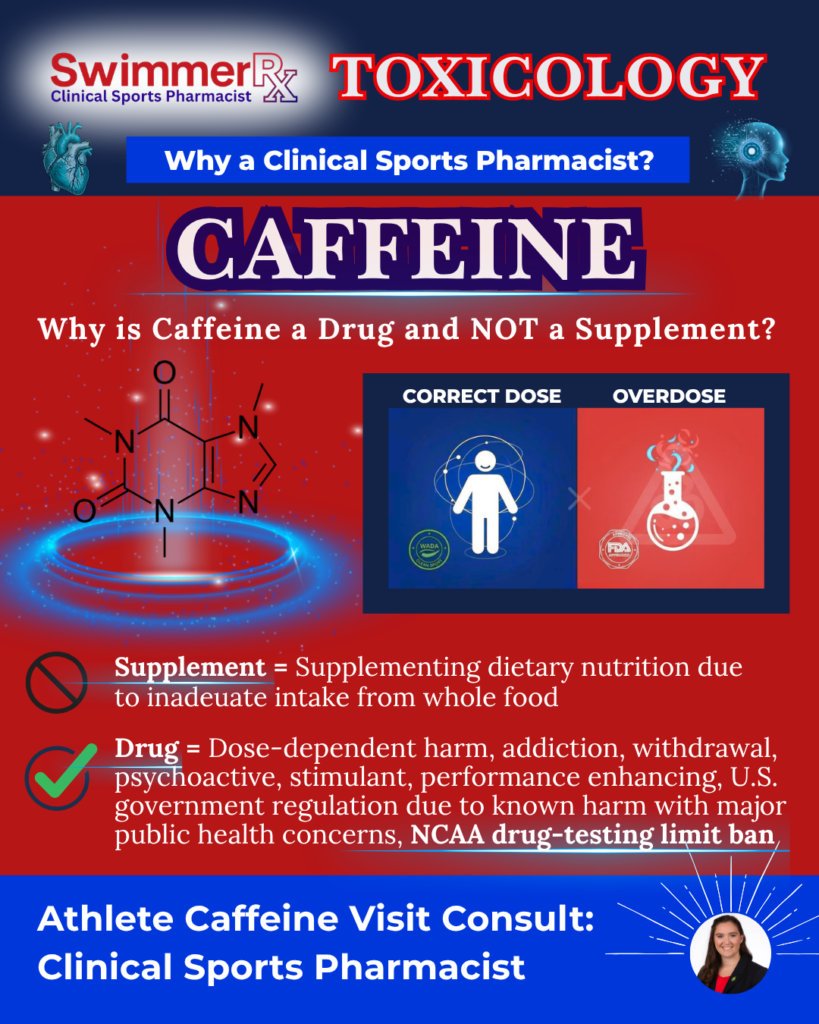
Caffeine: Why It’s actually a Drug & Not Just a “Supplement”
Caffeine is everywhere in sports.
Pre-workouts. Energy drinks. Coffee before races. Powders shared on pool decks.
And most athletes think of it as a supplement—something you take to “boost” performance.
But clinically, that’s not accurate.
Caffeine is a drug.
And understanding that distinction is what separates guessing from performance optimization.
What Defines a Supplement vs a Drug?
What is a Supplement?
A supplement is meant to:
- Support normal nutrition
- Fill gaps in dietary intake
- Maintain baseline health
Think:
- Vitamins
- Minerals
- Macronutrient support
A supplement should not significantly alter:
- Heart rate
- Brain function
- Physiologic systems
What is a Drug?
A drug:
- Produces dose-dependent physiologic effects
- Has mechanisms of action
- Has side effects and toxicity
- Can cause:
- Dependence
- Withdrawal
- Is regulated due to potential harm
Caffeine Checks Every Box of a Drug
Caffeine is:
- A central nervous system stimulant
- A psychoactive compound
- A performance-enhancing agent
Caffeine’s mechanism of actions (MOA) are primarily for what athletes are concerned about:
- Alters brain signaling (adenosine receptors)
- Increases heart rate and blood pressure
- Changes metabolism and energy utilization
And most importantly:
Its effects are dose-dependent
Dose Is Everything
At the right dose, caffeine can:
- Improve focus
- Increase reaction time
- Reduce perceived fatigue
- Enhance performance
At higher doses, it can cause:
- Jitteriness
- Anxiety
- GI distress
- Sleep disruption
- Cardiac effects (including arrhythmias in susceptible athletes)
Caffeine Dosing Is Toxicology – Why you need a Clinical Sports Pharmacist
The difference between:
✔️ Performance enhancement
vs.
❌ Harm
comes down to:
Dose + individual physiology
That’s toxicology.
Not “is it good or bad” but how much, for who, and in what context
Why This Matters for Athletes
When athletes think “supplement,” they assume:
- It’s safe, low risk of harm
- More is better for athletic performance
- Dosing doesn’t need to be precise like prescription medications
That mindset leads to:
- Overuse
- Inconsistent performance
- Increased risk
- Overdose
- Unwanted side effects
The NCAA Reality
Caffeine is monitored in competitive sports.
At high levels, it can:
- Trigger drug testing concerns
- Raise questions about misuse
This reinforces the point:
If it can affect eligibility…
it’s not just a supplement.
The Problem: No Precision
Most athletes:
- Don’t know their dose
- Don’t adjust for body weight
- Don’t account for metabolism
Athletes tend to take:
- “1 scoop”
- “Whatever their teammate uses”
- “If 1 scoop is good, then 2 scoops is better.” – A retired U.S. Paralympian
That’s not precise dosing.
That’s gambling with your performance and your health.
The Clinical Perspective on Caffeine
Caffeine should be approached like any other drug:
- Weight-based dosing
- Individualized strategy
- Monitoring response
- Adjusting for interactions
Because:
Performance is a physiologic outcome and you work too hard all season to not do your best!
Key Takeaway
Caffeine is not dangerous when used correctly to most athletes. But this is exactly why you get a healthcare team involved with your caffeine usage, not relying on teammates, coaches, nutritionists, or even sports dietitians. This is a drug, not food. It is being used for performance, not health. Therefore, you should automatically start thinking, “I need the expert in clean sport athletic performance.”
It is a drug with real effects, real risks, and real performance consequences.
Conclusion
If you treat caffeine like a supplement,
you’ll use it casually.
If you treat it like a drug,
you’ll use it strategically.
And that’s the difference between:
- Showing up hoping it works
vs - Showing up knowing it will
If you’re using caffeine without knowing your dose, metabolism, or interactions— you’re not “optimizing” performance. You are sacrificing your hard earned results.
Contact me here: Contact Us
or schedule a free 15-minute consultation Book a Meeting
to see if you’re a good candidate for a personalized caffeine consult.
Author: Dr. Marissa Blumenthal, PharmD, BCPS