
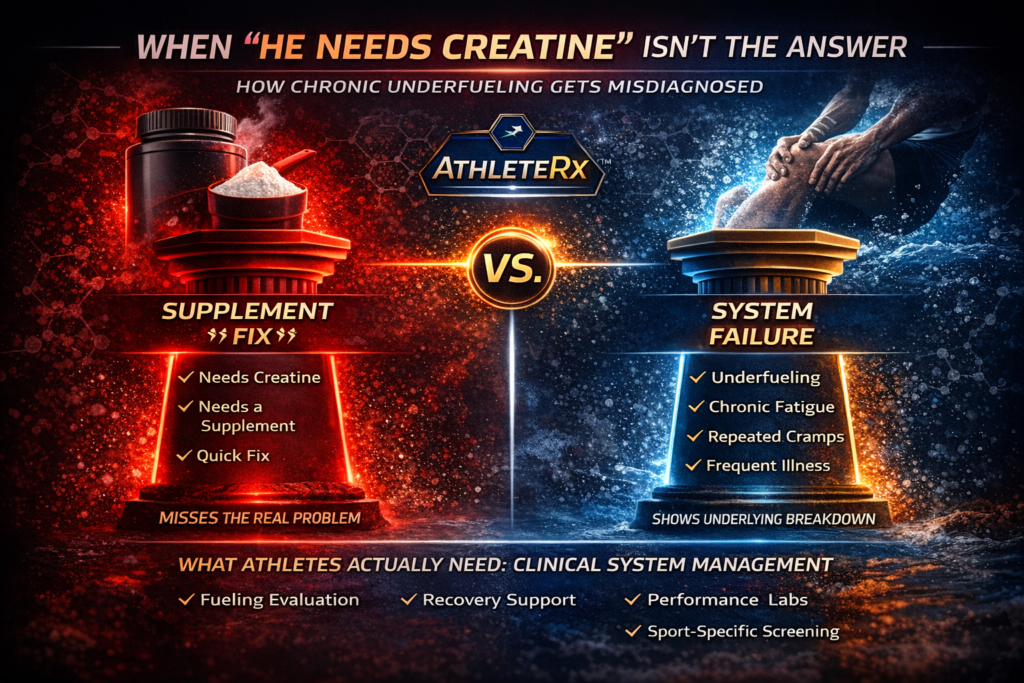
When “He Needs to Start Creatine” Isn’t the Answer
A Case Study in What Athletes Are Actually Missing
A swimmer came up and asked a simple question:
“My coach told me to start taking creatine. I bought it… but now what?”
On the surface, this is a supplement question.
In reality, it wasn’t.
⸻
The Situation
This athlete wasn’t just swimming.
He was:
Training multiple days per week in the pool
Adding self-imposed half-marathons every Sunday
During the week?
He was experiencing:
Full-body cramping
Repeated interruptions during practice
Inability to complete sessions
And beyond performance?
He was also dealing with:
Recurring upper respiratory tract infections
On-and-off ear infections
⸻
What Happened Next
No labs were done.
Parents declined bloodwork.
And one of the explanations offered was:
“He probably needs creatine.”
⸻
The Problem With That Answer
Creatine is not inherently wrong.
But it was completely misplaced in this situation.
Because the issue wasn’t:
lack of supplementation
lack of performance enhancers
The issue was:
a system that was no longer supporting the demands placed on it
⸻
What Was Actually Happening
From a clinical standpoint, several red flags were present.
⸻
1. Chronic Underfueling
Energy intake was not matching:
training volume
additional endurance load
This creates:
reduced recovery capacity
impaired adaptation
⸻
2. Low Energy Availability (LEA)
The body begins prioritizing survival over performance.
Early consequences:
fatigue
decreased output
poor recovery
Long-term risk:
Relative Energy Deficiency in Sport (RED-S)
⸻
3. Glycogen Depletion
Without adequate carbohydrate intake:
muscles cannot sustain output
recovery between sessions is compromised
This directly contributes to:
cramping and early fatigue
⸻
4. Immune System Suppression (CRITICAL ADD)
This is where the case becomes even more concerning.
The repeated:
upper respiratory infections
ear infections
are not isolated issues.
They are classic signs of:
chronic physiological stress and inadequate recovery
When energy availability is low:
immune function declines
susceptibility to infections increases
recovery from illness is delayed
This is a known pattern in athletes under high load with insufficient support.
⸻
5. Electrolyte Imbalance (Secondary)
Not always due to intake alone.
Often driven by:
repeated depletion
inadequate replenishment
systemic stress
⸻
6. Neuromuscular Fatigue
The nervous system is no longer firing efficiently.
Result:
increased susceptibility to cramping
decreased coordination and endurance
⸻
Why the Cramping Matters
This wasn’t “just cramps.”
This was:
a system-level failure signal
And when combined with:
recurrent illness
persistent fatigue
…it becomes even clearer:
The body is not coping with the load.
⸻
Why Creatine Doesn’t Fix This
Creatine:
does not correct low energy availability
does not restore glycogen stores
does not fix immune suppression
does not resolve recovery mismatch
At best:
→ no meaningful change
At worst:
→ delays addressing the real issue
⸻
The Bigger Issue
No one stopped to ask:
Why is this athlete adding endurance load on top of swim training?
Is he eating enough to support this?
Why is he getting sick repeatedly?
What is driving full-body cramping across multiple muscle groups?
⸻
The Missing Step: Clinical Evaluation
Bloodwork was declined.
That removes the ability to evaluate:
Iron status
Electrolyte levels
Markers of stress and recovery
Underlying contributors to recurrent illness
But even without labs:
There were enough clinical signs to justify concern.
⸻
What Should Have Happened
This situation required a shift away from products…
…and toward system management.
⸻
Step 1: Evaluate Load vs Recovery
Training volume
Additional endurance work
Rest patterns
⸻
Step 2: Correct Fueling
Adequate caloric intake
Proper carbohydrate timing
Post-training recovery nutrition
⸻
Step 3: Structure Hydration & Electrolytes
Not just fluid intake
Targeted electrolyte support based on load
⸻
Step 4: Address Immune Stress
Support recovery capacity
Reduce unnecessary load
Monitor illness patterns
⸻
Step 5: Monitor Response
Fatigue levels
Cramping frequency
Illness recurrence
Performance consistency
⸻
Step 6: Add Labs (When Possible but highly recommended)
To confirm:
deficiencies
imbalances
risk factors
⸻
The Real Lesson
This was never about creatine.
It was about what happens when:
training increases
recovery is not supported
immune signals are ignored
and symptoms are treated instead of interpreted
⸻
The Role of a Clinical Sports Pharmacist
This is where the gap becomes clear.
A Clinical Sports Pharmacist doesn’t ask:
“What supplement should we add?”
They ask:
“What is happening in the system—and what is actually driving this?”
Because athletes are not just training.
They are operating under:
physiological stress
metabolic demand
immune strain
performance pressure
And that requires clinical oversight, not guesswork.
⸻
Athletes don’t break down suddenly.
They show signs first:
fatigue
cramping
recurring illness
inconsistency
The problem is:
Those signs are often misinterpreted—or ignored.
⸻
CTA — Get Clarity on Your System
If something in your performance:
doesn’t make sense
isn’t improving
or keeps recurring
It’s time to stop guessing.
→ Schedule an AthleteRx Clinical Sports Pharmacist Consult
What you get:
Full system evaluation
Supplement + medication safety review
Performance and recovery analysis
Clear next steps based on your physiology
⸻
Athlete Healthcare is a Team Sport — and your pharmacist belongs on that team! 🏆
➡️ Book your consult now
By: Dr. Marissa Blumenthal, PharmD